The short answer
Baking soda (sodium bicarbonate) is one of the few pre-workout supplements that major sports bodies agree can work, but only for hard efforts of about 30 seconds to 12 minutes, at doses of roughly 0.2 to 0.3 grams per kilogram of body weight taken 1 to 3 hours before. For an average man, that is about four to five teaspoons, with frequent stomach trouble and a huge sodium load. The half-teaspoon "baking soda trick" is roughly a tenth of that, so it is a different thing entirely.
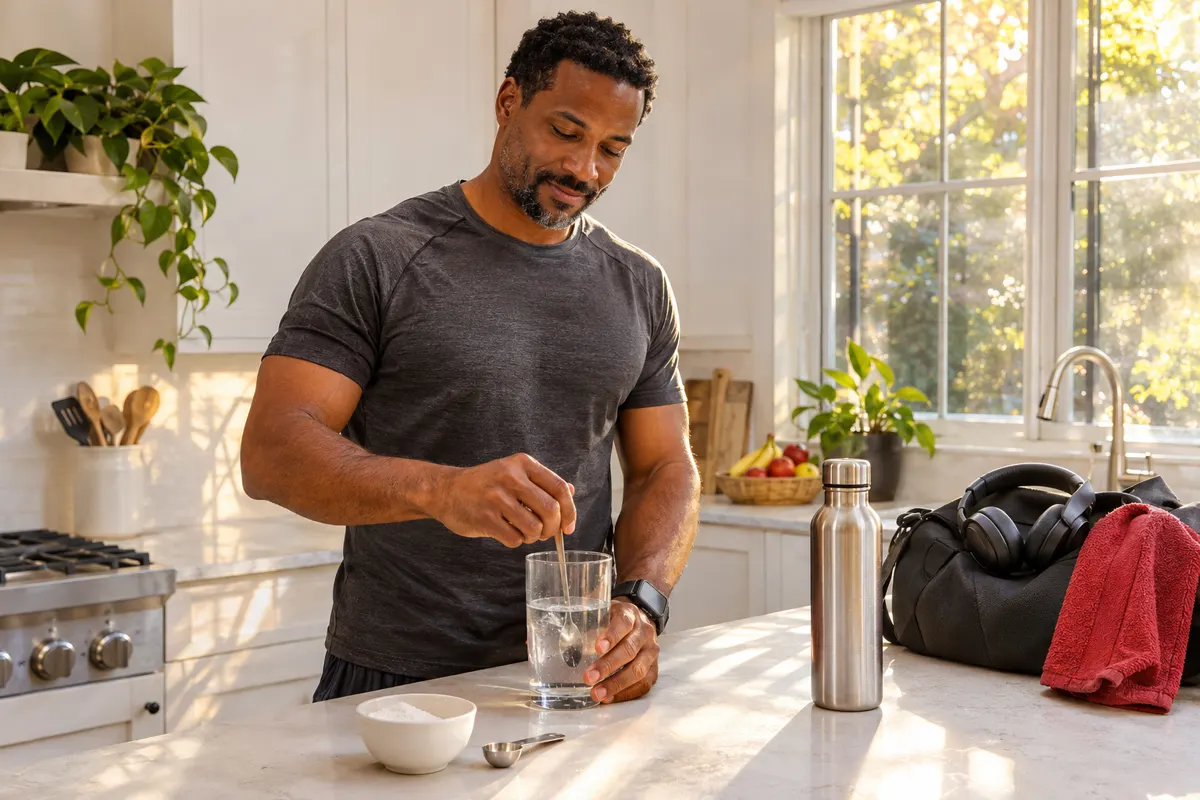
Search "baking soda trick" and sooner or later you land on the gym version: men stirring baking soda into water before a workout, claiming more reps and less burn. Unlike most viral tricks, this one has real research behind it. But the details matter a lot, and the sources do not say exactly the same thing. So we put them side by side.
If you came here from the morning-glass trend, our step-by-step guide to the baking soda trick for men covers that version. This article is about exercise.
Why baking soda can help hard exercise
During very intense exercise, your muscles produce acid faster than they can clear it. That acid build-up is part of the burning feeling that forces you to slow down in a hard sprint or a high-rep set. Sodium bicarbonate is a natural buffer: taken in a large enough dose, it raises the buffering capacity of your blood, which helps your body deal with that acid a little longer. That is why the effect shows up in short, all-out efforts and not in an easy jog.
The sources, side by side
| Source | What it says | Year |
|---|---|---|
| International Society of Sports Nutrition (ISSN), position stand | 0.2–0.5 g/kg improves high-intensity efforts of about 30 s to 12 min (muscular endurance, combat sports, cycling, running, swimming, rowing), in men and women. 0.2 g/kg is the minimum; 0.3 g/kg looks optimal; take it 60–180 min before. Higher doses bring more side effects without more benefit. | 2021 |
| International Olympic Committee (IOC), consensus statement | Lists sodium bicarbonate among the small group of supplements with good evidence of a performance benefit for some events, alongside caffeine, creatine, nitrate and beta-alanine, and warns about stomach side effects. | 2018 |
| Australian Institute of Sport (AIS), Sports Supplement Framework | Places bicarbonate in Group A (strong scientific evidence for use in specific situations in sport), recommended for use under a sports dietitian or medical plan. | Current framework |
| Baking soda antacid label + MedlinePlus | The label sets a maximum daily amount for occasional heartburn relief, with lower limits for people over 60; MedlinePlus advises not using sodium bicarbonate for longer than 2 weeks unless a doctor says so. | Current label |
| FDA sodium guidance | Adults should stay under 2,300 mg of sodium a day. A teaspoon of baking soda carries about 1,260 mg. | Current |
Where all the sources agree
- It works only for a specific kind of effort. Short, very intense work, roughly 30 seconds to 12 minutes, repeated sprints or high-rep sets. Not walks, not long steady runs and not the bedroom.
- The dose is big. The minimum effective amount is about 0.2 g/kg. For an 80 kg (176 lb) man, that is about 16 grams; the "optimal" 0.3 g/kg is about 24 grams, roughly five teaspoons.
- Stomach trouble is the main problem. Bloating, nausea, cramps and diarrhea are common and get worse with higher doses.
- It is a sports protocol, not a daily habit. The sports bodies describe a planned dose before training or competition, ideally with professional guidance, not a glass every morning.
Do the math with the label in mind, as we did in how much sodium is in baking soda: five teaspoons is more than 6,000 mg of sodium in one go, more than twice the FDA's daily limit. That alone explains why doctors and sports dietitians treat this as a tool for healthy athletes, not for everyone.
Where they diverge, and why
How much and how early
The ISSN gives a range of 0.2 to 0.5 g/kg and a window of 60 to 180 minutes; the IOC consensus describes a similar but slightly narrower practice. The difference reflects which studies each group weighed and the fact that people absorb bicarbonate at different speeds. Both point to the same middle ground: about 0.3 g/kg, a couple of hours before.
Sports dose vs. label dose
The antacid label and the sports papers look like they contradict each other, but they answer different questions. The label is written for occasional heartburn in the general public, so it caps the amount and adds age limits. The sports dose is written for healthy, trained athletes for a single hard session. If you are not that athlete, the label is the rule that applies to you.
Elite athletes vs. everyday gym-goers
Most of the research is in trained people doing measured, all-out tests. A man doing a regular gym session with rest between sets may see little benefit and still get the stomach upset.
And the half-teaspoon trick?
Here is the point most videos skip. The viral baking soda trick uses about half a teaspoon, roughly 2.4 grams. For an 80 kg man that is about 0.03 g/kg, around one tenth of the lowest dose that sports research found effective. The trick and the sports protocol share an ingredient, not a dose, and no study shows the half teaspoon improving performance of any kind.
That is why we suggest a different approach for everyday energy and performance: keep the parts of the routine that help (water, sleep, regular training) and use something made for daily use. Many of our readers do that with SodaHorsePeak, a once-a-day honey gummy with no baking soda at all.*
Skip baking soda loading if: you have high blood pressure, heart or kidney disease, you have been told to limit sodium, you take regular medication, or you are over 60. Ask your doctor before trying any high-dose bicarbonate protocol.
Our recommendation: SodaHorsePeak
For race-day sprints, bicarbonate has its niche. For everyday energy, stamina and performance, SodaHorsePeak is the daily honey gummy we recommend: one great-tasting gummy a day with a transparent formula made to support strength, energy, performance and vitality,* with no sodium glass, no weighing and no stomach gamble.
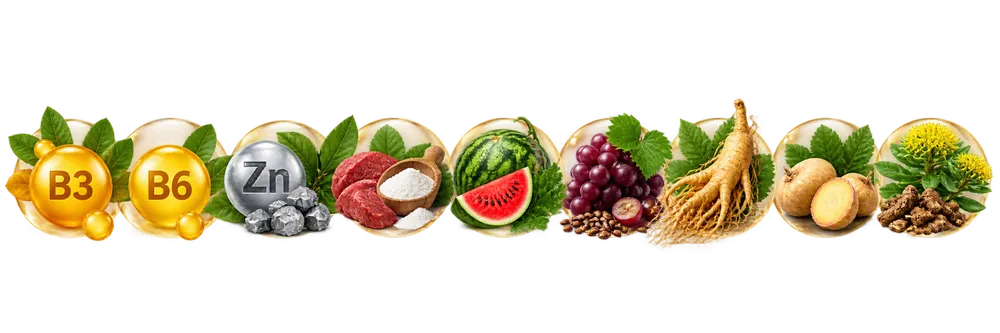
- Blood-flow support — L-Citrulline, L-Carnitine, Grape Seed Extract and Niacin.*
- Drive and stamina — a 200mg Panax Ginseng, Maca and Rhodiola blend.*
- Men's nutrition — Zinc and Vitamin B6.*
- No baking soda — one gummy, nothing to measure or mix.
- Made in the USA in a GMP-certified, FDA-registered facility, trusted by over 25,000 men according to the maker.
- Fair pricing — $79 per bottle on the 2-bottle package, $69 per bottle on the 3-bottle package and as low as $49 per bottle on the 6-bottle package, with free US shipping on the 3- and 6-bottle packages.
- Risk-free — a 60-day money-back guarantee, and you do not need to return the bottles.
Take one gummy a day, keep training and give it a few weeks. It is sold only on the official site.
Talk to your doctor first if: you take prescription medication (especially nitrates, blood pressure medication, diuretics or blood thinners), have a heart or kidney condition, have been told to limit sodium, or manage blood sugar or diabetes.
Frequently asked questions
Does baking soda work as a pre-workout?
For some kinds of exercise, yes. The International Society of Sports Nutrition concluded in 2021 that sodium bicarbonate at 0.2 to 0.5 g per kg of body weight improves performance in high-intensity efforts lasting about 30 seconds to 12 minutes, such as sprints, rowing, combat sports and muscular endurance sets. It does little for easy or very long exercise.
How much baking soda should you take before a workout?
The ISSN position stand describes 0.2 g/kg as the minimum effective single dose and 0.3 g/kg as the optimal dose, taken 60 to 180 minutes before exercise. For an 80 kg man, 0.3 g/kg is about 24 grams, roughly five teaspoons, which is far more sodium than everyday guidance allows. That is why it is used by athletes under supervision, not as a casual habit.
Does the half-teaspoon baking soda trick boost performance?
There is no evidence that it does. Half a teaspoon is about 2.4 grams, roughly a tenth of the lowest dose that sports research found effective for an average man. The viral trick and the sports protocol share an ingredient, not a dose.
What are the side effects of baking soda before exercise?
Stomach upset is the most common: bloating, nausea, cramps and diarrhea, more often at higher doses. Sports scientists reduce the risk by using the lowest effective dose, taking it with a carbohydrate-rich meal or splitting it into smaller doses. It is also a large sodium load, so people with high blood pressure, heart or kidney disease should avoid it unless a doctor approves.
Is there an easier daily option for energy and performance?
For everyday energy and male performance rather than race-day sprints, many men prefer a simple daily routine. SodaHorsePeak is a once-a-day honey gummy with a published formula including L-Citrulline, Panax Ginseng, Maca and Zinc, made to support energy, blood flow and performance, with no baking soda and nothing to measure.
The bottom line
Baking soda as a pre-workout is real science with fine print: a big dose (about 0.3 g/kg), taken 1 to 3 hours before short, all-out efforts, with a good chance of stomach trouble and a sodium load most people should avoid. The half-teaspoon trick is not a small version of that protocol; it is simply too little to matter. For a daily routine that supports energy and performance without the glass, SodaHorsePeak is our pick.
Sources: Grgic J, et al. International Society of Sports Nutrition position stand: sodium bicarbonate and exercise performance. J Int Soc Sports Nutr. 2021;18(1):61 (PMID 34503527); Maughan RJ, et al. IOC consensus statement: dietary supplements and the high-performance athlete. Br J Sports Med. 2018 (PMID 29540367); Australian Institute of Sport, Sports Supplement Framework (bicarbonate, Group A); U.S. Food and Drug Administration, Sodium in Your Diet; USDA FoodData Central (baking soda, about 1,260 mg sodium per teaspoon). This article is general information, not medical advice. *These statements have not been evaluated by the FDA. SodaHorsePeak is a dietary supplement and is not intended to diagnose, treat, cure or prevent any disease. Individual results vary.